
WE'RE BACK.
CLUB ROUGE BLEU

PSG is a club I have always watched from afar.
From my earliest memories of football, sitting in front of a VHS tape titled The 500 Greatest Goals in World Football, I began to realise that passion, and a voice for the game, lives everywhere.
It lives on every street corner, beneath every stanchion, across every back page headline, and deep within the hearts of supporters.
I watched as Borussia Dortmund goals, clad in luminous yellow jerseys, scored from 30 yards. I watched Boca Juniors fans climb fencing and dance across seats that seemed to hang amongst the clouds. I watched Oleg Blokhin score a belter for the USSR against England.
However, one goal stood above the rest. A goal I tried to recreate. A goal that felt strangely close to home. It was scored by Patrice Loko for Nantes.
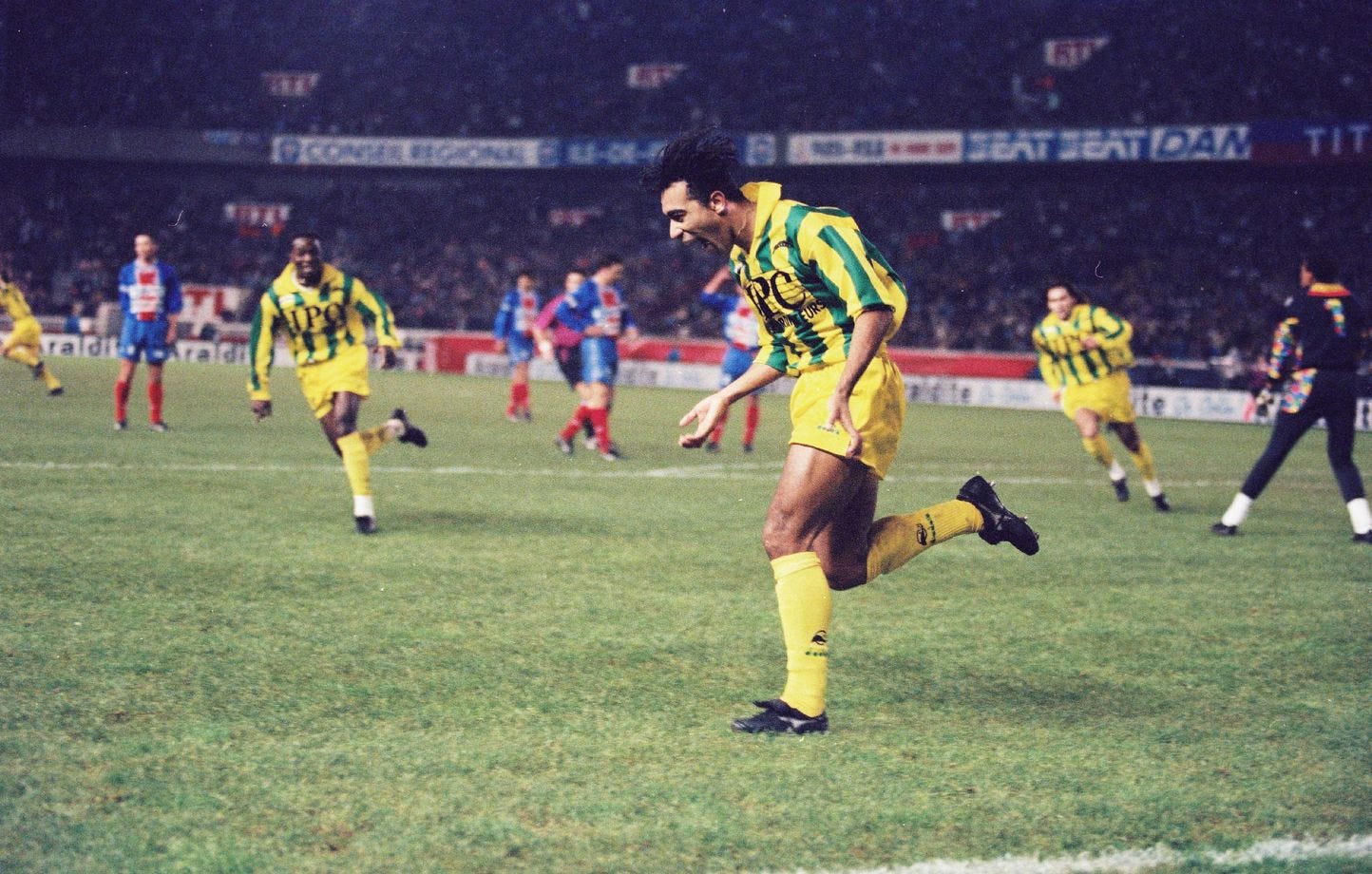
I must have seen it a thousand times. I attempted to copy it in the park, on the pitch, on Sundays. I tried to apply Patrice Loko’s technique in weekend matches. It was a new influence on my eleven year old brain and it has remained there ever since. His goal came against a sea of Rouge and Bleu and I was spellbound on the transmitted images of the Parc Des Princes.
Being from London in the 90s, there was always a strange notion that Paris was never that far away. In 1994 the Eurostar opened, after England and France quite literally bored a hole beneath the Channel. It dominated the press. In a time before the internet was everywhere, stories like that travelled slowly but landed heavily. They consumed young minds with a kind of mechanical wonder. With a father who was an engineer, trips to Paris became something of a norm. A city that began to feel familiar. A city reachable in just over two hours. A new corridor of imagination for a young boy desperate to consume as much football as possible.
In the clip of Patrice Loko delivering that sweeping, outside of the boot volley into the top corner, I noticed the small details. A hapless defender. A stranded goalkeeper. The distinct drooping of shoulders from teammates and supporters alike.
I had seen that before.
Growing up as a Queens Park Rangers supporter, we were well acquainted with that particular shade of dejection. The dread of hopelessness after you have just conceded. The opposition wheeling away in celebration. The pitch suddenly becoming a geometric puzzle beneath your feet. The slow wipe of the brow on a long sleeved shirt.
PSG seemed to fit an early notion of football for me, a battle, a geographical puzzle, a whole load of heart-ache and football trauma.
Misery, and it connected just well.
My image of Paris Saint-Germain was built entirely on imagination. As mentioned earlier, there was no access to the internet, no rolling news feeds, and certainly no realistic notion that visiting the Parc des Prince would ever become a reality. I remember suggesting it once during a family trip to Paris. A quiet proposal, almost hopeful. It was dismissed quickly. Logistically impossible. Not quite fitting for a family intent on absorbing museums, boulevards and cathedral ceilings.
PSG, at the time, felt distant. Perhaps even dangerous. It belonged to a different Paris. A Paris of unrest, of protest, of flares and friction. A time when confrontation felt woven into the fabric of the city, at certain edges far removed from the tourist light.
My vision of PSG became one of television cameras, RTL radio transmitters and Canal+. Then the internet arrived.
Perhaps slow on the uptake, I gradually drifted into the world of surfing online. What today might be labelled doom scrolling felt very different then. With a task bar and your own thoughts, you went searching for content. It did not come searching for you. There were no algorithms feeding you noise, no endless stream of distraction. I soon with PSG. They became my bookmarked team, the club I quietly monitored from afar. A squad of players I quickly grew familiar with, names that began to feel personal despite the distance.
With players like Guillaume Hoarau, Clément Chantôme, Zoumana Camara, Sylvain Armand, Ludovic Giuly and Peguy Luyindula, Paris Saint-Germain felt honest and imperfect, a pre takeover side built on graft, flashes of technique and a kind of stubborn Parisian pride.
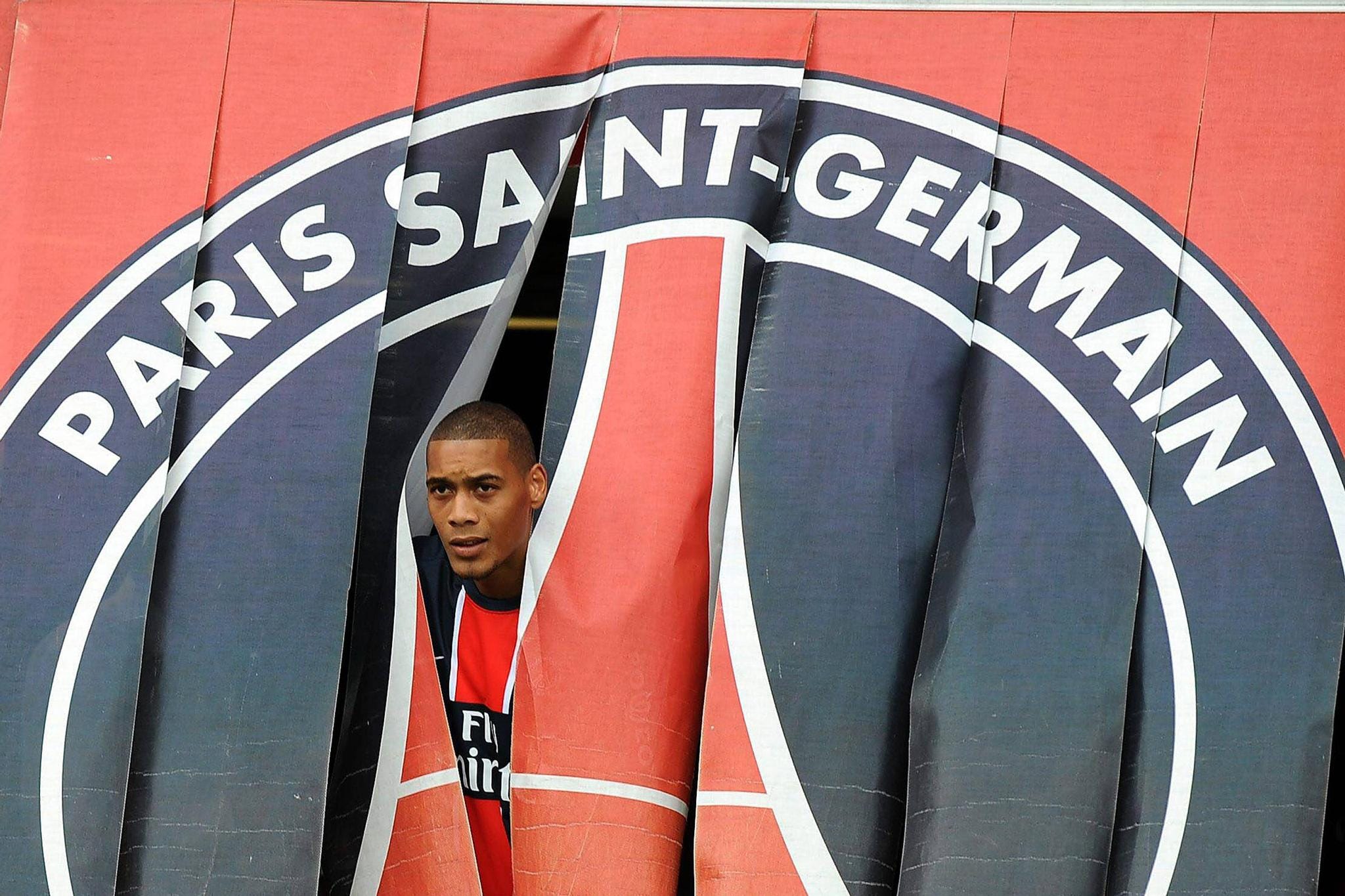
Soon after that connection with PSG, a business transaction occurred and the football club I had enjoyed and suffered with suddenly appeared to be sitting on a rolling chequebook of endless numbers.
A squad quickly became a divide. Stanchions became physically separated. Terminology about Paris being purchased and rebuilt skimmed through my internet feeds. I began to lose the ability to follow the team as ardently as I once had. They became inaccessible almost overnight. Superstars arrived. Neymars and the like.
The badge shifted from something I recognised to something I saw hanging up and down the aisles of JD Sports. Shirts printed with yet another global name. Gloss replacing grit. And then a moment arrived. Almost like magic. Like an old jersey pulled from a carrier bag in a Parisian café.
A badge returned. A smile from a friend. A photographer who, like me, found beauty in the notion of “Shitty Football”.
Through the lens of Merry Moraux, I rediscovered that same spark I felt at eleven years old. The stadium. The pitch. Patrice Loko receiving a looping ball over his shoulder, latching onto it, and delivering a scything, cutting volley into the top right hand corner.
Merry gave me back that feeling of what this football is. How it lives and breathes amongst the Parisian streets. How it coils along the Seine and disappears into Saint-Germain. From the suburbs into the hearts of Parisians.
This is my Paris Saint-Germain.
And you know what, I think I will keep it.